

MRM as Data Hub – Why Multi-Resource Management is More Than Appointment Coordination
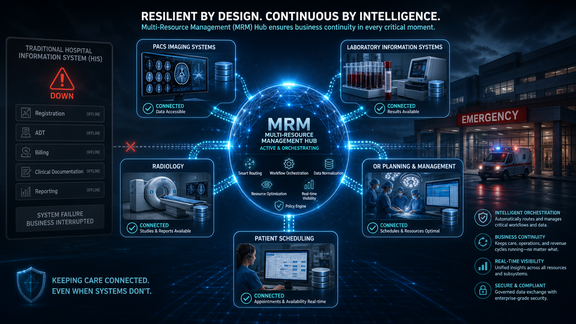
What happens when the Hospital Information System (HIS) fails – through cyberattack, technical failure, or scheduled maintenance? While classic backup systems focus on data security, medsolv.MRM offers a fundamental advantage: As the central planning and control instance, the multi-resource management system knows all subsystems, their interfaces, and can orchestrate direct data access – completely independent of the HIS.
Since clinical processes always have a temporal component and are tied to specific appointments, tasks, or resources, the MRM functions not only as a coordination tool, but as an intelligent data hub. It knows which examination takes place when, which systems are involved, and how to access their data. This presentation demonstrates how medsolv.MRM becomes a business continuity component and why modern hospitals should reevaluate their resource management as a strategic fallback concept.
The Underestimated System Architecture
Multi-resource management is understood in most hospitals primarily as a tool for appointment and capacity planning. But this perspective falls short. medsolv.MRM is in reality the central orchestration layer that connects all clinical subsystems – and precisely this architecture makes it a highly compelling backup solution in case of HIS (Hospital Information System) failure.
Why Clinical Data Always Has a Temporal Component
The crucial difference between a classic information system and an MRM lies in the process-oriented perspective:
- Every examination has an appointment – and this is managed in the MRM
- Every treatment requires resources – staff, rooms, equipment are coordinated in the MRM
- Every clinical record emerges in context – from a planned activity that the MRM knows about
This means: While the HIS stores and manages data, the MRM orchestrates the processes that lead to this data. It doesn't just know that patient X had an MRI examination, but when, where, with which device, by which staff and in which system the image data resides.
The MRM as System Expert: Access to All Subsystems
A modern multi-resource management system like medsolv.MRM integrates with numerous subsystems:
- Medical imaging (PACS/RIS) – MRI, CT, X-ray
- Laboratory (LIS) – Lab orders and results
- Functional diagnostics – ECG, ultrasound, endoscopy
- OR planning and OR documentation
- Radiation therapy and oncology
- Outpatient consultations and polyclinics
- Physiotherapy and other therapeutic areas
For each of these subsystems, the MRM knows:
- The interfaces (HL7, FHIR, REST APIs, proprietary protocols)
- The authentication mechanisms
- The data structures and access methods
- The context: Which appointment leads to which data in which system
The HIS Outage: When the Central Database Fails
During an HIS outage – whether due to ransomware, hardware problems, or critical updates – the central information supply typically collapses. Classic emergency concepts rely on:
- Paper-based processes (inefficient, error-prone)
- Fallback HIS like TwinKIS (additional complexity, parallel data storage)
- Read-only access to backup systems (no active process control)
medsolv.MRM offers a different approach:
Scenario: Emergency Operation with MRM as Data Hub
Situation: The HIS has failed. Hospital operations must continue.
What the MRM provides:
- Appointment scheduling continues – patients can be scheduled, resources coordinated
- Direct subsystem access – the MRM retrieves reports directly from PACS, LIS, RIS
- Contextual data provisioning – for each appointment, relevant previous examinations, lab values, and imaging data are aggregated from respective source systems
- Process control – orders can be sent to subsystems (lab order, imaging order)
- Documentation – basic clinical documentation can occur in the MRM and be synchronized to the HIS later
The key advantage: The MRM doesn't need to store all data itself. It knows the topology of the data landscape and can specifically access the systems where the data natively resides.
Technical Requirements for MRM as Backup Solution
For a multi-resource management system to fulfill this role, the following factors are crucial:
1. Independent Infrastructure
- Own server/VM, separate from HIS stack
- Own database (e.g., PostgreSQL or Microsoft SQL Server in medsolv.MRM)
- Redundant network connectivity
2. Direct Subsystem Integration
- APIs and interfaces to all relevant systems
- Authentication independent of HIS (e.g., via Keycloak/SSO)
- Caching mechanisms for critical master data
3. Intelligent Orchestration
- Rule-based access: Which data is needed from which system?
- Fallback logic: If system A doesn't respond, system B is checked
- Audit trail: All accesses are logged
4. Emergency Workflows
- Predefined processes for HIS outage
- Reduced functionality, but operational
- Synchronization routines for later HIS restoration
Why This Architecture Already Exists Today
The crucial point: This architecture is not a future vision, but already implemented – however, not understood as an emergency concept.
Modern MRM systems like medsolv.MRM must already for their regular operation:
- Communicate with all subsystems
- Retrieve patient data contextually
- Distribute orders to various systems
- Check availability in real-time
Using it as a backup system is therefore not a new function, but a strategic revaluation of existing capabilities.
Advantages Over Classic Backup Strategies
| Aspect | Fallback HIS (e.g., TwinKIS) | medsolv.MRM as Backup |
|---|---|---|
| Investment | Additional system, separate license | Already present, dual use |
| Data storage | Parallel data storage, synchronization needed | Access to original data in subsystems |
| Complexity | New user interface, training | Familiar environment, no transition |
| Currency | Dependent on sync intervals | Real-time access to subsystems |
| Process coverage | Basic functions | Full process control for diagnostics/therapy |
Challenges and Limitations
Realistic assessment:
An MRM cannot completely replace an HIS in an emergency, but it can:
- Maintain diagnostic and therapeutic operations
- Control time-critical processes (OR, imaging, lab)
- Manage patient flow and resource utilization
Limitations:
- No complete electronic health record
- Limited administrative functions (billing, controlling)
- No nursing documentation (except appointment-related services)
But: For the first 24-72 hours of an HIS outage – the critical phase – an MRM offers significantly better business continuity than paper-based emergency processes.
Strategic Recommendations for Hospital IT
- Inventory: Which subsystems are directly connected to the MRM?
- Interface verification: Do these function even without an active HIS?
- Emergency playbook: Which processes run via the MRM during an outage?
- Master data caching: Store critical patient master data in the MRM
- Training: Prepare staff for MRM-centric emergency operations
- Tests: Regularly simulate failure scenarios
Conclusion: Paradigm Shift in Thinking About MRM
Multi-resource management is more than an appointment calendar. It is the procedural intelligence layer that understands how clinical workflows function, which systems are involved, and how data becomes information.
medsolv.MRM demonstrates: When you consistently design the architecture for subsystem integration and time-based process orchestration, a system emerges that can become a data hub in emergencies – not because it stores all data, but because it knows where it is and how to retrieve it.
In times of increasing cyber threats and rising requirements for business continuity, hospitals should strategically reevaluate their MRM systems: Not only as an efficiency tool, but as a critical infrastructure component for emergency operations.