

Clear structures for complex organizations
Multiple locations, one system: A new type of multi-client capability in the leading multi-resource management system medsolv.MRM separates resources and patients according to their criteria. For example, doctors, rooms, and patients can be assigned to locations—the appointment search automatically takes this into account. Clear structures, fewer errors.
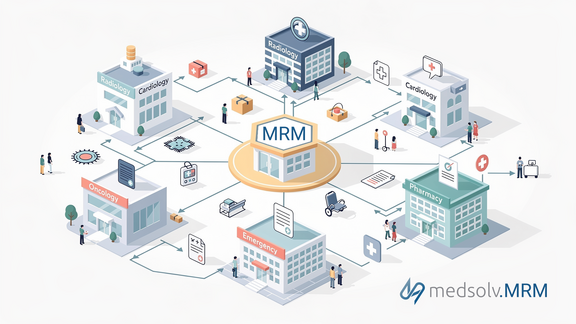
New multi-client capability in MRM: Clear structures for complex organizations
Medical facilities are growing. And with them, complexity is growing too: multiple locations, different departments, different patient groups. The MRM appointment and resource management system now offers a generic system for the structured separation of resources and patients.
What the system achieves
The new multi-client capability allows you to group and separate resources and patients according to freely definable criteria. You determine the separation criteria yourself: locations, departments, patient types, or other categories relevant to your organization.
At the same time, you specify which users are allowed to access which areas—for reading, planning, or both.
Flexibility in resource planning
One doctor works at one location? Easy to assign. One doctor works at multiple locations? Just as easy. The system maps what happens in practice—not the other way around.
- Dr. Adam is assigned to location A.
- Dr. Bernhard is assigned to location B.
- Dr. Christ works at locations A and B. It is easy to determine when she is working where.
- Dr. Dreher is assigned to location D.
The configuration follows your organizational structure. If this changes, you can adjust the assignments.
Appointment search from the patient's perspective
Multi-client capability has a direct impact on appointment searches. The system delivers suitable results depending on patient loyalty:
- Patient Paukner needs an appointment quickly and is not tied to any particular location. MRM searches all locations and displays the next available appointments—with Dr. Adam, Dr. Bernhard, Dr. Christ, or Dr. Dreher.
- Patient Ritscher is tied to location B. The search returns appointments with Dr. Bernhard or Dr. Christ, provided they are working at location B.
- Patient Schwedes is a patient of Dr. Christ. The system finds appointments with Dr. Christ – at location A or B, depending on their availability.
The result: The appointment search automatically takes into account the stored assignments. Reception staff do not need to know which doctor is working where and when. The system knows.
Clearly defined user rights
Who is permitted to view what? Who is permitted to plan? You assign permissions per user and client. Reception staff at location A can view the resources and patients at location A. Those responsible for the organization can view everything. Everyone works with the data that is relevant to their tasks.
Configuration and inheritance
Configuration is carried out by authorized users in a clearly structured interface. A practical inheritance principle applies here: the user's client assignment is automatically transferred to all data that they create.
An employee at location B creates a new patient record – this is automatically assigned to location B. No additional clicks, no source of error.
Users with access to multiple clients have a choice: if an employee with authorization for locations C and D creates a data record, they decide during creation whether it is assigned to C, D, or both.
The system supports daily work without complicating it.
Conclusion
The new multi-client capability is generic: you define the separation criteria yourself – locations, departments, patient types, or whatever your organization requires. Everything is controlled centrally in one client, without you having to switch between different systems.
Access control is clear and transparent, but not overly complex. Each user sees and edits exactly the data that is relevant to their work. The configuration itself is manageable – not a project that takes weeks, but a setup that can be completed in a few hours.
And your data protection officers? They will like the system. Clear assignments, traceable authorizations, documented accesses. This is what data protection looks like when it works without paralyzing operations.